Jordan’s “No Refrigeration Necesario” Pasta

Jordan
Jordan, Peace Corp Volunteer in El Salvador

Jordan cooked very little until she joined the Peace Corps.  She is now a Rural Health and Sanitation volunteer in San Jeronimo, El Salvador.  She lives in “el campo”, aka “the country”.  The cooked food in El Salvador contains lots of salt which gives her migraines.  So much for her host family cooking for her every night.

Volunteers get $400 dollars to set up house for their two-and-a-half year stay.  She didn’t have enough left over after she bought a mattress, a two-burner stove, pots and pans and hammock to buy a refrigerator.  El Salvador uses the American dollar as currency and things aren’t so cheap there.  Sometimes more expensive.  For a small fridge (we’re talking college size), she would have to pay about $300.

Before she arrived in El Salvador, she didn’t like beans, eggs or avocados, but she eats them now.  Jordan goes to the nearest pueblo, San Miguel which is 1.5 hours away, once a week to buy her vegetables and other stuff from the Super Selectos.  Sometimes the vegetable truck comes into her canton and she purchases them from the vendor.  She spends about $30 on food for the month that she prepares at home.  Vegetables are very cheap, so because she has no refrigerator, she saves lots of money not buying meat and processed foods.  She purchases her bags of water daily from the neighborhood tienda.

Jordan “eats to live” now instead of “lives to eat”.  She’s lost 30 pounds in a few months time and is still losing.  She has unwillingly cut out sugar, protein and diet coke from her diet. She claims it’s “too hot to eat”.  She is in the hottest part of El Salvador where a simple walk across the street can necessitate a wardrobe change.

Her kitchen is outdoors on her balcony and consists of a plastic table with a two-burner stove on top fueled by propane.

There is plastic seating for two.  She has one tea towel, which she uses to wipe her hands and doubles as a pot holder.  She has a small metal skillet and a small pot with a lid, which looks like something you played with at pre-school when you were 5.

She has one coffee cup and a couple of dishes and cups and a few utensils.  She has one decoration which states “So Much To Do, So Few People To Do It For Me”.

 A small bowl holds her vegetables and eggs and a basket holds her non-perishables.

Jordan’s “No Refrigeration Necesario” Pasta

Dice up whatever vegetables you have.

Jordan used:  Green pepper, onion, pipian (a small green and white squash) and tomatoes.

Add a small amount of oil in a skillet and saute all vegetables over medium heat (except for the tomato) until soft.  Then add the tomato and cook for 1 minute.  Add “salsa”, or spaghetti sauce.  Keep warm.

Salsa, aka Spaghetti Sauce, and Pasta

Meanwhile, bring water to a boil and add pasta and cook according to directions.  Drain pasta.

Top pasta with vegetable/sauce mixture.

Heat up a tortilla on a “plancha”(toaster)

and serve with a bag of Augu El Jordan water.

Buen Provecho!

Sabroso!

Beatriz’s Tortillas

Beatriz de El Salvador

Written July 22, 2010

 In El Salvador, at the end of the chicken bus route, about 1.5 hours away from San Miguel, lies the small canton of San Jeronimo.  It is there that my daughter, Jordan, is a Peace Corps volunteer, and the place where I was introduced to Beatriz.  Beatriz, 22, lives with her mother, a 9 year old sister and her 99 year old grandmother.  Her uncle lives in a house next door.  San Jeronimo is a “remesa” village, where relatives live in the states and send money back each month.  They live pretty good here compared to other areas.
Beatriz’s kitchen

Her kitchen is fairly well equipped with a stove and a refrigerator.  These are items not usually found in many homes in El Salvador.  It is decorated in the typical El Salvadoran style, with colorful tablecloths and wall decorations.

Beatriz is a well educated woman in El Salvador.  She finished high school , which is extremely uncommon, and is not married, which is REALLY uncommon.  The university costs too much, so she’s decided to stay and live with her family in this small canton.

She tends the chickens and makes corn tortillas.  She makes about one hundred every other day and has been at it since she was eleven.  She is either making the tortillas from scratch, or warming them up on a toaster “plancha” on the stove.  Tortillas can take up a majority of a woman’s day in Central America.

Tortillas take up much time, but also lots of wood for the fire.

There is quite a problem with the lack of trees in El Salvador and tortilla making contributes to the tree problem, believe it or not.

A fire is built in some type of iron or heat proof container.  Many of these fires are right in the house, obviously with much ventilation.  A “comal” sits on top of the fire.  A “comal” is a gigantic iron skillet-with-no sides apparatus that is curved and shallow.

Comal

When I arrived at Beatriz’s cinderblock house, she was ready for us.  She had already made the dough for the tortillas, which consist of cornmeal and water.

She places this beach ball sized dough on a rock with legs called a “piedra”, which means rock in spanish.

Piedra

There is a pan of water beside it.  She expertly measures a small amount and makes a ball.  She kneads the ball of dough back and forth between her hands until she is ready to start shaping it into a round.

With her left hand on the bottom and her right hand on the top she begins to flatten and expand the disc.  It is very important, apparently, to rotate the disc toward you and not away from you, which I was scolded for many times.  Apply pressure to the top while shaping it and move it with the bottom hand.  It’s always important to have the correct wetness as well.

A perfect tortilla

This is as complicated as it sounds.  My hands seized up after making about eight of these little monsters.

The best part of the day was when grandma started laughing hysterically, pointing and saying in Caliche, “She’s learning, she’s learning, she’s learning…..”

Beatriz’s 99 year old grandmother laughing at me

It was so funny to her that I’d never made a tortilla, like I was some sort of freak.

Me embarrassing myself

In all of her 99 years, she’d never met a woman who didn’t make tortillas.  Jordan joined in the tortilla making, so that took the pressure off.

Amigas, Beatriz and Jordan (the Peace Corps volunteer)

Jordan had learned to make the thicker tortillas from another family in the west of the country.  Corn tortillas in the east/oriente part of El Salvador are larger “mas grande”  and thinner than in the west/oxidente.  The ones in the east are thicker and about the size of your palm.  Personally, I like the thinner ones better.

Once the disc is the right size, then you wet your left hand, place the thick disk into it and start slapping it and twisting it with the other hand.

Another way to do it, is to slap it back and forth between your hands.  I picked this way, due to the fact that I liked to tear them the other way and couldn’t quite get it right.  Once the disc is about as big as a DVD, you put it on the comal.

Beatriz greased an area of the comal with a scrap of someone’s denim jeans dipped in oil, and placed the tortilla on it.  After about two minutes, she flips it with her fingers.  To hell with spatulas.  Another two minutes, the tortillas start to puff up and she removes them the throws them into a large plastic basket with holes.

Although Beatriz did not make fun of me, she never let me cook a tortilla without taking it from me and perfecting it.  She was very direct to let me know that she needed to put on the final touch before cooking.

Tortillas are eaten with every meal in El Salvador, along with red pureed beans, cheese, eggs and vegetables.  They are used in the place of a fork.  You can also make them into a pupusa, in which typically pork and cheese are added to the middle at the thick stage and fried on a comal as well.  These are served with cabbage and a red sauce.

One day I will try to make these at home, but the GE four burner stove and my mom’s iron skillet will have to do.  (And I’ll always have backup store bought tortillas on hand, just in case.)

Ashley’s Yakisoba

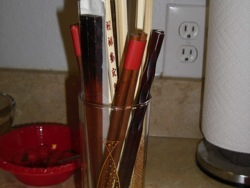
chopsticksI was so excited when Paula’s daughter, Ashley C., agreed to cook for Regular Cooks.  She is a young girl and a young cook.   She just started cooking when she recently got married.

When I walked into Ashley C’s house in downtown Elizabeth City, I was greeted with soothing Japanese music and two beautiful tablescapes:  One for tea and the other was a coffee table decorated with lovely candles in the Asian style.

The TV was playing old Bruce Lee movies.  We were ready for Yakisoba.


I had never heard of Yakisoba and had to Google it.  My husband is not crazy about Japanese food, so we never go to restaurants that serve it and besides a few teriyaki marinaded chicken or beef dinners, I didn’t have much experience with it.

Ashley and her husband, Jeremy, are newlyweds.  They are both from Elizabeth City.  Their kitchen has been renovated and Ashley has decorated it in her unique style, with an old and new mix.


Jeremy’s job takes them all over the country and in October they are moving to Japan for six months. They are very excited about it except for the fact that they are going to be issued bicycles and not a car when they arrive.

Apparently Yakisoba can be made 100 different ways.  All of which calls for the Japanese buckwheat noodles, called Soba noodles.

Ashley keeps it simple.  Even though she holds no formal job, she doesn’t want to get into fancy cooking every night….and she does cook every night.  She and Jeremy are not crazy about some of the restaurants in town and would rather spend it together in their cozy house with a nice bottle of wine.  They really enjoy each other’s company.

Ashley was almost apologetic about not cooking Yakisoba like the other recipes she’d seen.  She actually refers to hers as “Fake” Yakisoba.  She said she didn’t even have a wok.  But I had to remind her that this blog is about regular cooks cooking what they cook with what they have in their own kitchens.  She makes this dish quite frequently and it’s a healthy choice for them.

Today she made Yakisoba for a crowd, however, since she and Jeremy are newlyweds, I will give you the recipe for two.  Awww, isn’t that cute?

Ashley’s Yakisoba    Serves 2     

First get your water boiling for the noodles.

Meanwhile, Ashley began prepping her vegetables.  She uses an onion, a red pepper and a green pepper and cuts them into bite-sized pieces.


She also minces a clove of garlic and about the same amount of grated fresh ginger, although she uses the powdered kind also if she doesn’t have fresh.


She then cuts up two breasts of chicken into bite sized pieces.

Watch those fingers!

She starts by sauteing half the garlic and ginger for about 30 seconds over medium heat and then adds the chicken, some salt and pepper and cooks until almost done and then adds 1/4 cup of soy sauce.

She sautes the remainder of the garlic and ginger in a separate pan with the onions and peppers over medium heat and sautes the vegetables together until translucent.


When the water starts boiling add the package of Soba noodles and cook for 3 minutes.  Drain noodles and serve with vegetables and chicken.  If the noodles stick, you can add a little oil.


Ashley served a watermelon salad with rice wine vinegar, sugar, mint and ginger.

And for dessert, her sister, Tracy, made a dairy-free rice pudding with coconut milk, cooked pears and toasted coconut.


YUMMY SOBA.


Ashley's Yakisoba Recipes

  • Servings: 2
  • Difficulty: moderate
  • Print

Grocery List

  • 2 Breast of Chicken
  • 1 9.5 oz (approx) Soba Buckwheat Noodles
  • 1 Onion, 1 Red Pepper, 1 Green Pepper, 1 Clove Garlic
  • Grated Ginger to taste
  • 1/4 Cup Soy Sauce
  1. Get your water boiling for the noodles.
  2. Cut an onion, a red pepper and a green pepper and cut them into bite-sized pieces.  Mince a clove of garlic and about the same amount of grated fresh ginger (or a 1/2 tsp of ground ginger)
  3. Cut up two breasts of chicken into bite sized pieces.
  4. Saute half of the garlic and ginger for about 30 seconds over medium heat and then add the chicken, some salt and pepper and cook until almost done.
  5. Add 1/4 cup of soy sauce.
  6. Saute the other half of the garlic and ginger in a separate pan over medium heat and saute the vegetables together until translucent.
  7. When the water starts boiling add approx 9.5 oz package of Soba noodles and cook for 3 minutes.  Drain noodles and serve with vegetables and chicken.  If the noodles stick, you can add a little oil.  Serve with Soy Sauce.

Watermelon and Mint Salad

Grocery List

  • 1/2 large watermelon
  • 1 Tbsp fresh mint
  • 1 tsp fresh grated ginger
  • 1 Tbsp sugar
  1. Scoop 1/2 of a watermelon into balls with a melon baller.
  2. Mix melon balls, 1/4 cup of rice wine vinegar, 1 Tbsp of sugar, 1 Tbsp on fresh mint chopped and 1 tsp of fresh grated ginger.
  3. Chill for at least an hour.
  4. Serve chilled.

Tracy’s No-Dairy Rice Pudding

Aunt Toe’s Macaroni and Cheese

Aunt Toe
Aunt Toe

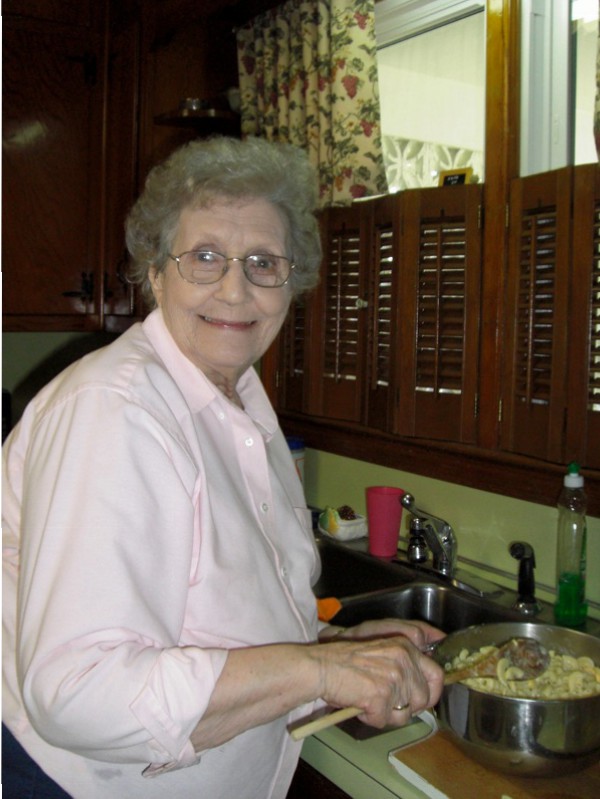
Aunt Toe (aka Ottolene with no middle initial) is my mother’s younger sister.  We went to visit her in Bristol, VA once a year in the summer and stayed a week.  She spoiled us all rotten with her wonderful cooking and hospitality.  She would get upset if any of us went to stay with another relative.  She wanted to “hog” us.

We would always have a picnic at her house with all the relatives.  Her husband, A.H., would cook on the grill and Aunt Toe would make many of the side dishes.  The other relatives always brought their specialities and things that us “out-of-towners” especially liked, for instance, Cherry Yum Yum, broccoli casserole, green beans and numerous salads and desserts.  But Aunt Toe always made the macaroni and cheese.  She did this because it was about the only thing her grandkids would eat.  You see, Aunt Toe was a marvelous cook, however, she was blessed with a food picky husband, son and grandchildren.  I believe this had to be genetic.  The list would wrap around this blog of how many foods this family wouldn’t touch, try or would barely tolerate on a plate.  Because she loved them dearly, she prepared the plain and the ordinary for them, when she could have been a restaurant chef.

5733_226747475216_891250216_7599628_4204849_n
Picky Son
Picky Grandson
Picky Grandson
I intend to post numerous versions of macaroni and cheese.  First and foremost, because it’s southern.  It’s everybody’s favorite side dish and can be made so many different ways.  Aunt Toe’s version is simple, so I will start with hers.
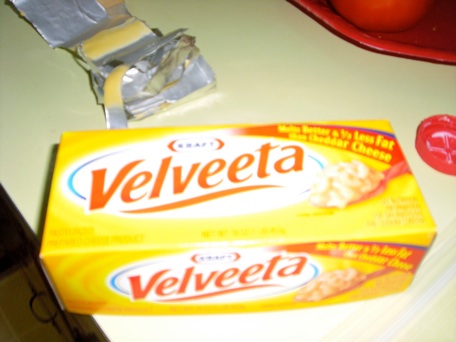
Aunt Toe uses Velveeta Cheese and shredded cheese in her recipe.  Even though Velveeta gets a bad wrap, you have to admit, it’s still good.  And, oh so cheesy!

The macaroni and cheese she made for this entry was for a family reunion that we have every July 4th weekend.  Instead of her getting the family together, the cousins are doing it now and the old folks just come and relax.  It is currently held at “Meadowbrook Farm”, my cousin, Eula Lee’s farm,  in Bristol. Complete with a restored farmhouse, barns, farm animals, dogs, a minnow pond and a babbling brook. 5733_226747425216_891250216_7599621_1483969_n

The reunion always starts out with Cousin Johnny saying grace and remembering each of our deceased loved ones by name.  After a few tear wipes and nose blows, we grab our Chinet and head for the table.  5733_226747430216_891250216_7599622_7203492_n

The next noises to be heard are lots of good belly laughs and an occasional, “Get on over here for the picture,” that always accompany a Graybeal family reunion.

5733_226747450216_891250216_7599624_4262331_n
Graybeal Cousins — Yes, I’m the youngest
CIMG1772
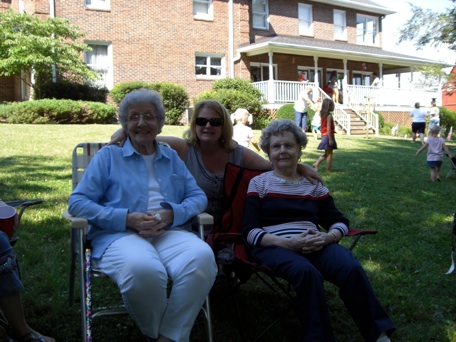
Two matriarchs of the Graybeal Family, Aunt Toe and Aunt Ada Lynn, and me

Aunt Toe’s Macaroni & Cheese

Prepare a 16 oz. box of macaroni according to the package directions.  Drain and put back into the pot. CIMG1768

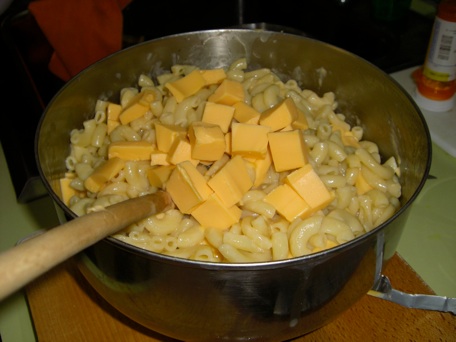
Add 1/2 stick of butter (cut up), about 12 oz (or more to taste) of Velveeta Cheese (cut into cubes), and 1 cup or more of milk (not too thin, not too thick).CIMG1770
Put a large handful of shredded cheddar cheese (sharp would be best) into the pot and mix into the macaroni.

Pour mixture into a greased casserole dish.

Cover with more of the cheddar cheese and bake at 400 degrees for 20 minutes until cheese is bubbly.CIMG1771

Serve with sweet tea and whatever else is on the table.